The lights of Broadway have welcomed many film-to-stage adaptations, but few have sparked as much curiosity—and skepticism—as The Lost Boys. The 1987 cult vampire film, known for its neon-drenched aesthetic, rock soundtrack, and Corey-led heartthrobs, has long been a fan favorite. So when news broke of a stage musical adaptation, audiences wondered: can the anarchic, sun-soaked horror-comedy survive the transfer from screen to stage? Critics have now spoken, and their verdicts are as divided as the vampires and humans in Santa Carla.
This isn’t just another nostalgia play—it’s a high-stakes attempt to revitalize a genre-bending original. And the critical reception reflects that tension: some see brilliance in its bold reinvention, while others argue it loses the soul of what made the original unforgettable.
The Critical Consensus: A Divided but Engaged Audience
Early reviews from major outlets paint a conflicted but passionate picture. The New York Times called the production “a chaotic, glittering fever dream of 80s excess,” praising its visual ambition while noting that “the heart of the original feels buried under spectacle.” Meanwhile, The Hollywood Reporter was more forgiving, dubbing it “a surprisingly emotional ride that honors the source material’s rebellious spirit.”
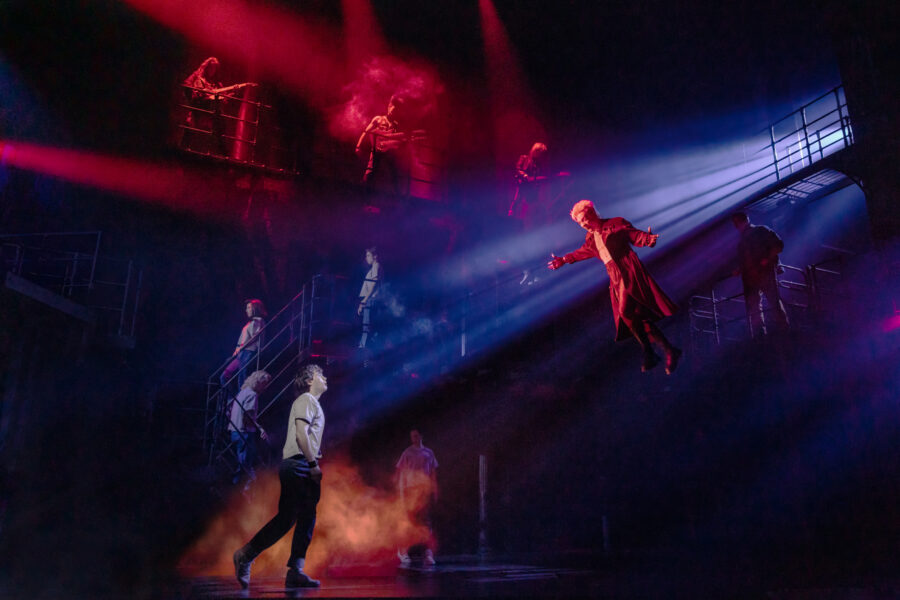
What’s consistent across reviews is acknowledgment of the show’s energy. Critics agree: The Lost Boys on Broadway doesn’t tiptoe. It crashes through the fourth wall with leather jackets, synth-pop, and a stage-filling vampire lair that evokes both a subway tunnel and an underground nightclub.
Yet, for every critic enamored with the spectacle, another laments the loss of subtlety. Variety noted, “The film thrived on ambiguity—the line between teenage rebellion and true evil was thin. Here, the stakes are too clean, too loud.”
Still, the adaptation’s willingness to take risks has earned it grudging respect. Even negative reviews often end with a nod to its ambition.
Strengths Highlighted by Supportive Critics
Supporters of the stage version zero in on several standout elements that successfully translate—or reinvent—the film’s essence.
A Soundtrack That Pulses
with Energy
The musical score, composed by Duncan Sheik (known for Spring Awakening), blends synthwave, glam rock, and theatrical ballads. Critics from Time Out New York and Playbill praised the number “Edge of the Night,” performed by the character Sam (played on opening night by newcomer Dax Santiago), as “a torch song for the latchkey generation.” The reimagined version of INXS’s “Never Tear Us Apart,” performed as a duet between Michael and Star during a moonlit chase sequence, earned a standing ovation at the premiere and multiple mentions in reviews.
David: A Charismatic Villain Reborn
Many critics pointed to the portrayal of David, the vampire leader, as the show’s breakthrough performance. Played by Hadestown alum Phillipa Soo in a gender-bent casting choice, David is described as “hypnotic,” “dangerously magnetic,” and “the best thing on stage this season” (The Wrap). The decision to cast a woman in the role adds new layers to the character’s predatory allure and the pack’s dynamics, with Vulture noting, “It’s not just stunt casting—it changes the power games in subtle, thrilling ways.”
Visual Design That Captures the Film’s Spirit
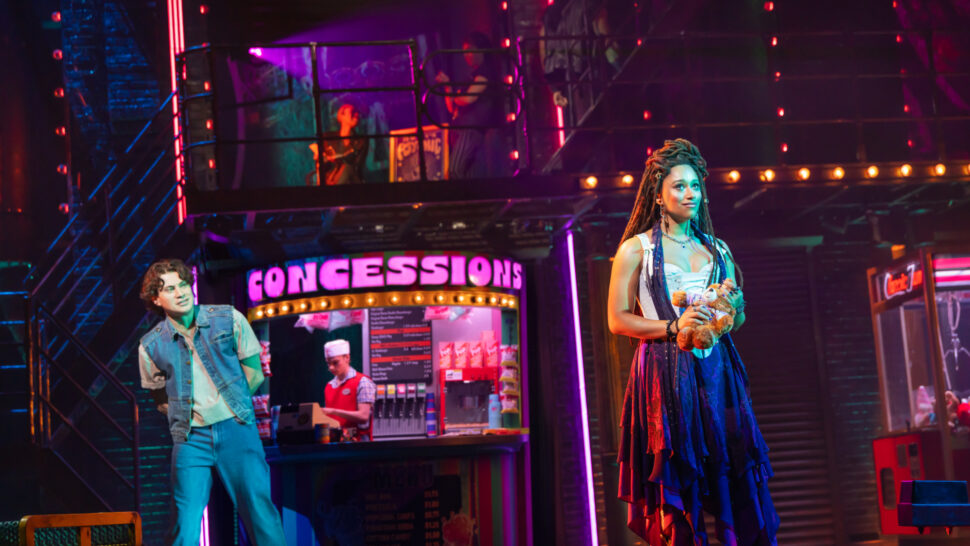
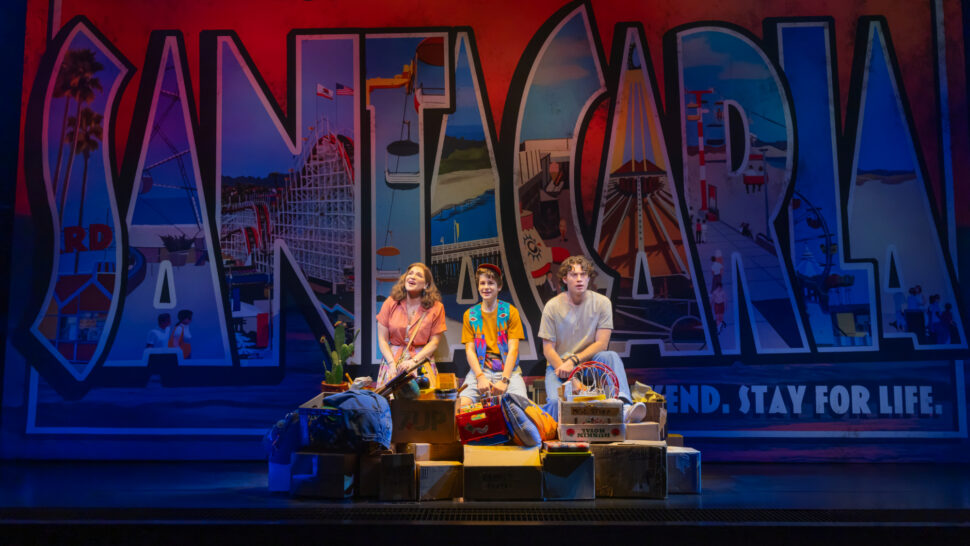
The set design, led by Christine Jones (American Idiot, Harry Potter and the Cursed Child), has drawn universal acclaim. The boardwalk of Santa Carla is rendered in warped metal, flickering neon, and augmented reality projections that make the Ferris wheel appear to spin into the audience. Critics at Deadline called it “a haunted amusement park sprung to life,” while The Guardian wrote, “You don’t just watch this world—you feel its sticky floors and smell its cotton candy decay.”
Criticisms: Where the Stage Version Stumbles For all its strengths, the adaptation has not escaped criticism—some of it sharp.
Pacing Issues in the Second Act
Multiple reviewers noted that the musical sags in its second half. The New Yorker observed, “The first act zips by like a stolen motorcycle. The second feels like riding in circles.” The attempt to deepen the emotional arcs of Michael and Lucy (the boys’ mother, played by Tony nominee Ana Villafañe) slows momentum, with several new ballads failing to land with the same power as the ensemble numbers.
Overreliance on Nostalgia
Some critics argue the show leans too heavily on fan service. “Every frame feels like a cue for audience giggles,” wrote IndieWire, “but laughter shouldn’t replace narrative tension.” References to “One for the money” and the comic book store are present—and loudly cheered—but often at the expense of character development.
The Comedy Doesn’t Always Bite
The film’s dark humor walked a tightrope between satire and horror. On stage, some jokes fall flat. The character of Grandpa, originally a bumbling comic relief, is expanded into a full subplot involving a conspiracy theory podcast. While meant to be meta, critics found it “forced” (Rolling Stone) and “a distraction from the real story.”
How Does It Compare to Other Film-to-Stage Horror Musicals?
The Lost Boys joins a growing list of horror films adapted for Broadway, including The Rocky Horror Show, Carrie: The Musical, and Beetlejuice. Critics have inevitably drawn comparisons.
| Show | Faithfulness to Source | Critical Reception | Stage Innovation |
|---|---|---|---|
| The Rocky Horror Show | High | Cult classic, lauded | Pioneered immersive theater |
| Carrie (2012 revival) | Medium | Mixed, later reappraised | Powerful use of stagecraft |
| Beetlejuice | Loose | Generally positive | Creative puppetry, pop score |
| The Lost Boys | Selective | Divided | Bold visuals, gender-swapped lead |
What sets The Lost Boys apart is its refusal to play it safe. Unlike Beetlejuice, which leaned into wackiness, or Carrie, which doubled down on tragedy, the Lost Boys adaptation straddles tones—sometimes successfully, sometimes not. As Entertainment Weekly put it: “It’s not the best horror musical on Broadway—but it might be the most interesting.”
Audience Reactions: Enthusiasm Meets Confusion
While critics remain split, audience reactions are more polarized by demographics. Millennials and Gen X fans of the original film tend to embrace the show’s nostalgia and energy. “It’s like being 14 again,” one patron told Playbill after the matinee. “But with better lighting.”
Younger attendees, unfamiliar with the film, often report confusion. “I loved the music, but I didn’t get who David was supposed to be,” said a college student interviewed outside the theater. This generational divide is reflected in online reviews, with strong 5-star and 1-star ratings dominating platforms like TodayTix and TheaterMania.
Is It Worth Seeing? A Balanced Verdict So, should you buy a ticket?
If you’re a fan of the original film, yes—but go with tempered expectations. This isn’t a carbon copy. It’s a reinterpretation that amplifies the style, expands the mythology, and occasionally missteps in tone. The production design and lead performance alone are worth the price of admission for many.
If you’re new to The Lost Boys, approach with caution. The story assumes familiarity, and without it, some emotional beats and jokes may land flat. Consider watching the film first—or at least reading a plot summary.
And if you’re a lover of bold, theatrical experiments that prioritize vision over polish? This show is essential viewing. Even in failure, it does something rare: it takes risks.
Final Word: A Flawed Gem with Fangs
The Lost Boys on Broadway won’t unite critics. It’s too loud for some, too weird for others, and too nostalgic for purists. But in an era of safe, algorithm-driven adaptations, its audacity is refreshing.
The show may not live forever—but it burns bright while it’s here.
FAQ
Is The Lost Boys on Broadway a direct remake of the movie? No—it reimagines key plot points, includes new songs, and features gender-swapped roles. While it follows the core story, it takes creative liberties with tone and character.
How faithful is the musical to the original film’s plot? It keeps the central narrative—two brothers moving to Santa Carla, one falling in with vampires—but expands secondary characters and adds new subplots, especially around the town’s mythology.
Who plays David in the Broadway version? Phillipa Soo plays a reimagined, female-led David. Her performance has been widely praised for its intensity and vocal prowess.
Are the original movie stars involved in the production? No original cast members are in the show, though Kiefer Sutherland (who played David in the film) recorded a pre-show message for opening night.
Is the musical appropriate for children? It’s recommended for ages 13+. The show includes stylized violence, intense scenes, and mature themes, though no graphic gore.
Does the stage version include the film’s iconic quotes? Yes—lines like “One for the money” and “Lost boys wear black” are included, often delivered with a wink to the audience.
Has the show received any major award nominations? As of now, it hasn’t been eligible for Tony Awards (previews began late in the season), but industry chatter suggests nods in design and performance categories next year.
FAQ
What should you look for in Critics Weigh In on The Lost Boys Broadway Adaptation? Focus on relevance, practical value, and how well the solution matches real user intent.
Is Critics Weigh In on The Lost Boys Broadway Adaptation suitable for beginners? That depends on the workflow, but a clear step-by-step approach usually makes it easier to start.
How do you compare options around Critics Weigh In on The Lost Boys Broadway Adaptation? Compare features, trust signals, limitations, pricing, and ease of implementation.
What mistakes should you avoid? Avoid generic choices, weak validation, and decisions based only on marketing claims.
What is the next best step? Shortlist the most relevant options, validate them quickly, and refine from real-world results.